Checklist de transformation IA — Roadmap et déploiement pratique
Votre plan d'action complet pour transformer votre organisation avec l'IA. De la gouvernance à la mesure, étape par étape.
Vous avez maintenant les concepts. Voici le plan d'exécution.
Ce guide synthétise les 19 articles précédents en une roadmap concrète pour transformer votre organisation.
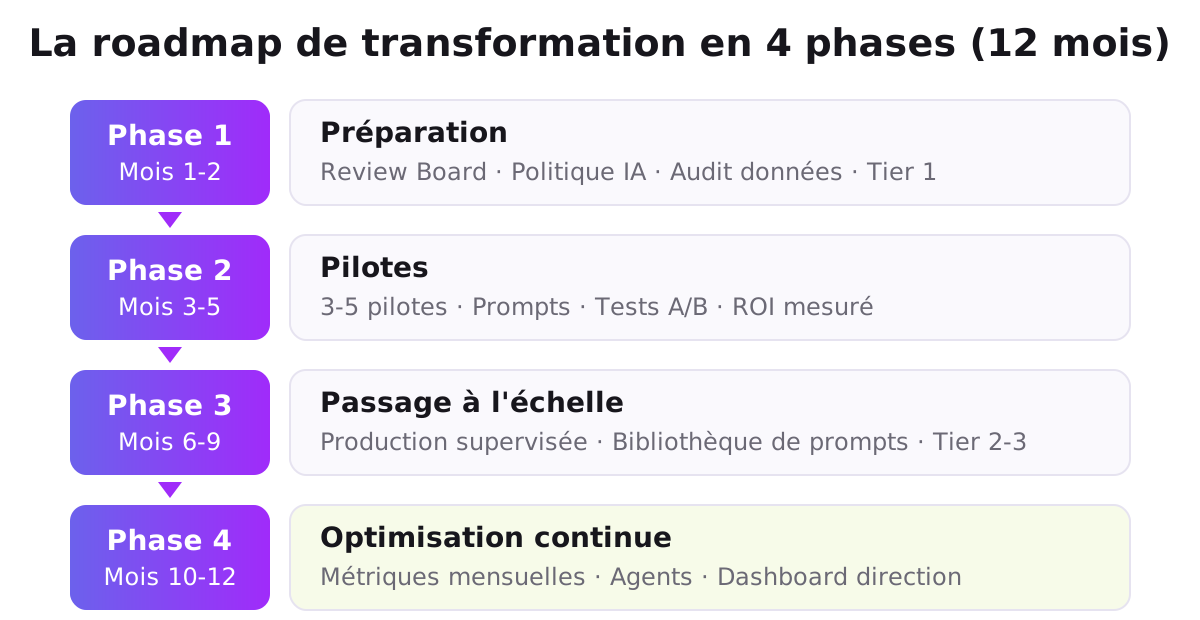
Phase 1 : Préparation (Mois 1-2)
✓ Gouvernance préalable
- [ ] Créer un AI Review Board (CAO, CTO, légal, risques, métier)
- [ ] Définir la politique IA (usages autorisés, données sensibles, escalade)
- [ ] Évaluer maturité IA actuelle (voir article 5)
- Score < 10/25 ? → Commencer petit (un pilot)
- Score 10-15/25 ? → Préparation 6 mois, puis scale
- Score 15+/25 ? → Déployer sur 3-4 initiatives simultanées
- [ ] Clarifier rôles et responsabilités
- Chief AI Officer (ou désigné)
- AI Governance team (2-3 personnes)
- Audit & Compliance (link à existing risk team)
- Per-department AI champion
✓ Data audit
- [ ] Classifier toutes données : publiques / internes / confidentielles / sensibles (RGPD)
- [ ] Documenter source, retention, access controls
- [ ] Vérifier conformité RGPD + Data Protection (article 8)
- Contrats de traitement de données (DPA) avec cloud providers
- Anonymisation/pseudonymisation où possible
- [ ] Établir baseline de confidentialité
- Pas de données PII dans prompts sans consentement
- Audit trail pour accès données sensibles
✓ Training & comms (Bloc 1)
- [ ] Briefer leadership (30 min, deck "Pourquoi l'IA change la donne")
- [ ] Créer "AI Literacy" program (Tier 1)
- 2-hour session : Concepts, risques, prompting basics
- Tous les employees, mandat
- [ ] Lancer internal communication
- Blog interne "AI transformation journey"
- FAQ (peurs courants : "Va-t-on être remplacé ?")
Success metrics (Phase 1)
- Board formation ✓
- Policy drafted ✓
- 80%+ workforce trained ✓
- Maturity score established ✓
Phase 2 : Pilots (Mois 3-5)
✓ Sélectionner 3-5 pilots
Critères de sélection:
Impact High (50+ people affected)
Risk Medium (no mission-critical dependencies)
Timeline Short (result in 4-6 weeks)
Buy-in Strong (champion existe dans la team)
Exemples par fonction:
| Fonction | Use case | Tempo |
|---|---|---|
| Customer Support | AI ticket routing (article 15) | 4 weeks |
| Sales | Proposal draft + personalization | 5 weeks |
| HR | Resume screening (article 15) | 3 weeks |
| Finance | Invoice processing (article 15) | 6 weeks |
| Content | Draft generation + editing | 3 weeks |
✓ Pour chaque pilot
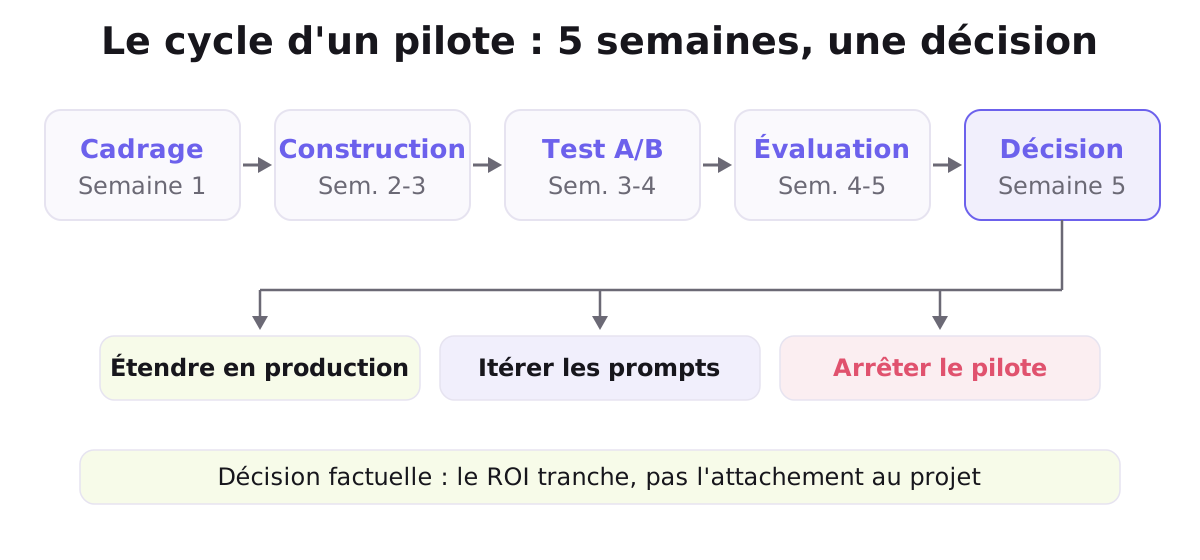
Setup (Week 1):
- [ ] Nommer un pilot lead (ownership)
- [ ] Assembler équipe (2-3 people, 20% time)
- [ ] Définir success criteria
- Quantitative (time saved, quality, cost)
- Qualitative (team feedback, adoption)
Build (Week 2-3):
- [ ] Define tool + workflow (Claude API / ChatGPT / Copilot)
- [ ] Gather existing data/examples (100 historical cases)
- [ ] Craft prompts (article 9-12 techniques)
- [ ] Manual QA on sample (20-30 examples)
- Accuracy: % correct outputs
- Hallucinations: % where AI invented facts
- Speed: time per task
Test (Week 3-4):
- [ ] A/B test with real users (10-20% traffic/volume)
- Traditional workflow vs AI workflow
- Measure: quality, speed, user satisfaction
- [ ] Document learnings (what worked, what didn't)
- [ ] Refine prompts based on failures
Evaluate (Week 4-5):
- [ ] Calculate ROI
- Cost of AI (API, labor time) vs benefit (time saved, quality gain)
- Example: "Invoice processing: 10 hrs/week saved at $50/hr = $26k/year benefit. AI cost = $5k/year. ROI = 5x."
- [ ] Collect team feedback
- NPS: "Would you use this again?" (target > 7/10)
- Bottlenecks: Where did it slow down?
- [ ] Decide: Scale? Iterate? Kill?
Monitoring checklist (article 16)
- [ ] Logging : Every AI action logged to database (timestamp, input, output, human review)
- [ ] Alerts : If error rate > 5%, notify team
- [ ] Feedback loop : Users rate AI output (👍/👎)
- If 👎 : Reason logged → feed into prompt refinement
Success metrics (Phase 2)
- 3+ pilots launched ✓
- 2+ show positive ROI ✓
- Team confidence in AI ↑ (NPS 6+) ✓
- Process documented ✓
Phase 3 : Scale (Mois 6-9)
✓ Roll successful pilots to production
For each scaled pilot:
- [ ] Supervised automation (article 15) until confidence > 80%
- AI generates, human approves before execution
- [ ] Build approval workflow (Jira/Slack integration)
- Queue of AI outputs waiting human sign-off
- SLA: approve within 2 hours
- [ ] Create incident response playbook
- If AI fails, how do we rollback?
- Who do we escalate to?
✓ Expand to new use cases
- [ ] Select 5-10 secondary pilots (lower risk, new functions)
- [ ] Reuse playbook from Phase 2 (faster tempo : 2-3 weeks each)
- [ ] Build internal prompt library (Notion/GitHub)
- "Customer support triage prompt v2.3" (production-tested)
- "Invoice OCR + validation" (known accuracy: 94%)
- Anyone in org can fork and adapt
✓ Upskilling (article 17)
Tier 2 training (for roles using AI daily):
- [ ] 1-2 week advanced prompting course
- Chain-of-thought, RAG, few-shot examples
- Building workflows (Claude → tool → Claude loop)
- [ ] Tool integration practical (integrate Claude into Slack/Figma/etc)
Tier 3 training (new AI roles):
- [ ] Agents & automation deep dive (3-4 week course)
- [ ] Build small agent locally (Python + Claude API)
- [ ] Deploy to test environment
✓ Org structure
- [ ] Centralized AI governance (policy, audit, risk)
- [ ] Decentralized execution (each team has AI champion)
- [ ] Monthly syncs : Share learnings, blockers, new prompts
Success metrics (Phase 3)
- 50%+ of org using AI in daily work ✓
- 3+ pilots running in production ✓
- Internal prompt library with 20+ templates ✓
- 2nd cohort trained (Tier 2) ✓
- Cost savings > projected budget ✓
Phase 4 : Optimize & Innovate (Mois 10-12)
✓ Continuous improvement cycle (article 16)
Monthly:
-
[ ] Review metrics dashboard
- Automation rate (% of tasks auto-completed)
- Error rate (track downward trend)
- User satisfaction (monthly NPS)
- Cost per task (track downward as volume scales)
-
[ ] Analyze failure modes
- Top 3 reasons AI failed this month
- Refine prompts for each
-
[ ] A/B test prompt improvements
- Deploy refined prompt to 20% of traffic
- Compare vs control (error rate, speed, quality)
- Roll out if better
Quarterly:
- [ ] Upskill new cohort (Tier 1 or 2)
- [ ] Assess new tools
- Claude 4 available? Better multimodal? Benchmark vs current
- New agents frameworks? Evaluate
- [ ] Expand to new functions (not yet AI-enabled)
- Target: 75% of org using AI
✓ Advanced capabilities
-
[ ] Agents (article 13-16)
- Move beyond single-task AI
- Multi-step workflows (research → analysis → communication)
- Measure agent efficiency gains
-
[ ] Knowledge integration (article 10)
- Connect AI to internal knowledge base (wiki, docs, databases)
- AI retrieves context before answering (reduces hallucinations)
-
[ ] Custom models (optional, article 18)
- If very high volume + specific domain, fine-tune or use smaller model
- Cost savings may justify investment
✓ Leadership dashboard (article 20)
-
[ ] Build CEO/Board dashboard
- KPI 1: Productivity gain (hours saved/month)
- KPI 2: Cost savings ($ ROI)
- KPI 3: Adoption rate (% org using)
- KPI 4: Risk incidents (0 target)
- Trend: all going up/down?
-
[ ] Monthly exec briefing
- What's working? → Expand
- What's not? → Kill
- What's next?
Success metrics (Phase 4)
- 75%+ org adoption ✓
- 5+ production pilots ✓
- Positive ROI confirmed ✓
- Continuous improvement process in place ✓
- Leadership confidence high ✓
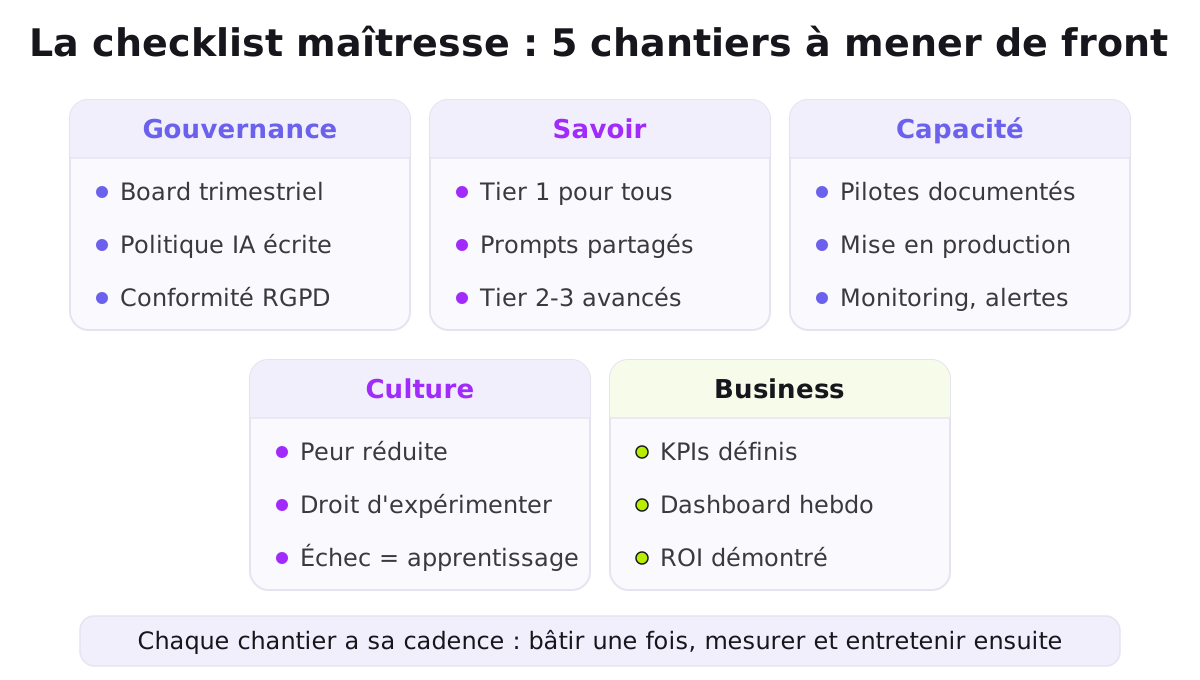
Master Checklist : Transformation Complète
Governance (Do once, maintain ongoing)
- [ ] AI Review Board established + quarterly cadence
- [ ] AI Policy documented (dos/don'ts, data handling, escalation)
- [ ] Roles assigned (CAO, Governance team, per-team champions)
- [ ] Compliance verified (RGPD, Data Protection, legal)
- [ ] Risk framework in place (see article 6)
Knowledge (Build, iterate)
- [ ] Workforce trained Tier 1 (all employees, AI literacy)
- [ ] Advanced training created (Tier 2 for AI users, Tier 3 for specialists)
- [ ] Internal documentation (prompt library, best practices, playbooks)
- [ ] Communication cadence (monthly updates, success stories)
Capability (Build, measure)
- [ ] Pilots completed (3-5, documented results)
- [ ] Successful pilots scaled (production-ready, monitored)
- [ ] Additional use cases identified (next wave)
- [ ] Monitoring infrastructure in place (logs, alerts, dashboards)
Culture (Sustain)
- [ ] Fear reduced (communication, success stories, redeployment not layoff)
- [ ] Experimentation encouraged (budget for new pilots)
- [ ] Learning continuous (upskilling programs, certifications)
- [ ] Psychological safety high (failures are learning, not punishment)
Business (Track & report)
- [ ] Metrics defined (productivity, cost, adoption, risk)
- [ ] Dashboard live (weekly review cadence)
- [ ] ROI calculated (savings vs investment)
- [ ] Executive alignment (board sees value, funds next phase)
Red Flags : Transformation Is Struggling
❌ Sign 1 : Adoption stalled (< 20% using after 6 months)
Likely causes:
- Tools are hard to use
- Team didn't get trained
- No clear benefit communicated
- Fear of replacement high
Fix:
- Simplify workflow (fewer steps, better UX)
- Run Tier 1 training again (hands-on demo, not lecture)
- Show specific ROI (time saved, quality up)
- Share redeployment story ("Jane now does X instead of Y")
❌ Sign 2 : Error rate not improving (stuck > 5%)
Likely causes:
- Prompts aren't being refined
- Data quality issue (garbage in → garbage out)
- Tool isn't right for task
- No feedback loop (failures not logged)
Fix:
- Monthly prompt refinement (A/B test improvements)
- Audit input data (completeness, accuracy)
- Revisit tool choice (Claude vs GPT vs Llama?)
- Add user feedback loop (👍/👎 after each output)
❌ Sign 3 : Cost spiraling (spending > projected)
Likely causes:
- Token usage higher than estimated
- Too many parallel pilots
- Inefficient prompts (long, redundant)
Fix:
- Optimize prompts (shorter, more specific)
- Consolidate pilots (kill weak ones)
- Use caching (if using Claude, cache system prompts)
- Consider cheaper model for certain tasks (Haiku vs Opus?)
❌ Sign 4 : Security incident
Likely causes:
- Sensitive data leaked in prompt
- No approval workflow (wrong decision escalated)
- Governance not enforced
Fix:
- Incident post-mortem (what happened, why?)
- Retrain team (no PII in prompts)
- Strengthen approval (human review mandatory for high-risk)
- Audit all past outputs (any data leaked?)
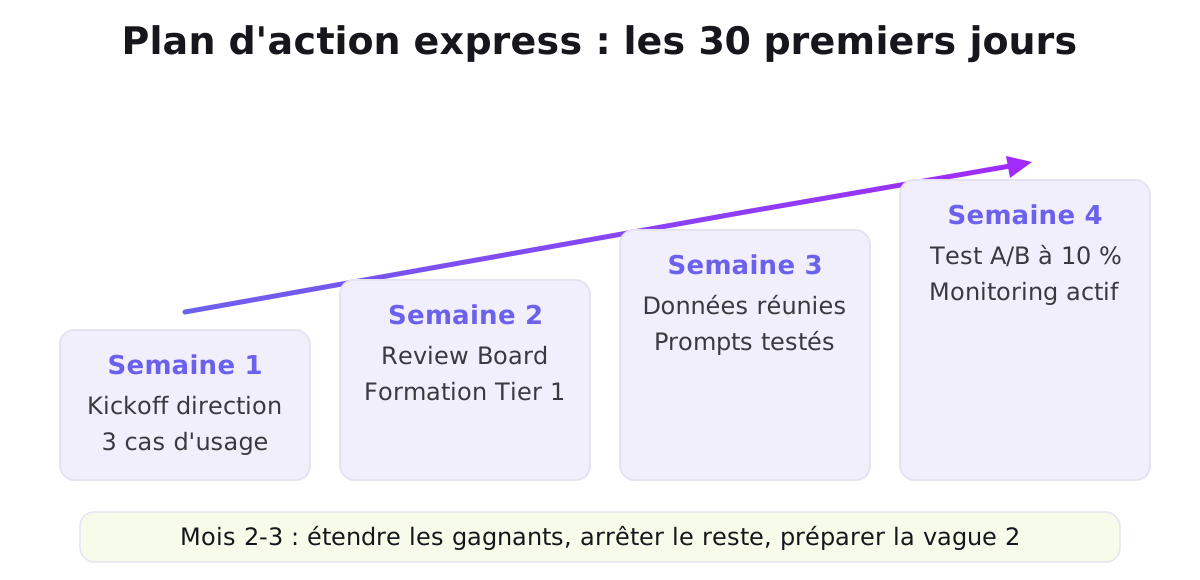
Quick-Start Action Plan (Next 30 Days)
Week 1
- [ ] Schedule kickoff meeting : CEO, CTO, CAO, team leads
- Message: "We're starting AI transformation. Here's why + how."
- [ ] Draft AI Policy (use article 6 as template)
- [ ] Identify 3 use cases (customer support, content, finance)
Week 2
- [ ] Finalize AI Review Board (assign CAO, governance lead, etc)
- [ ] Launch Tier 1 training cohort 1 (50 people, 2-hour session)
- [ ] Select pilot leads (one per use case)
Week 3
- [ ] Pilot teams gather data (100 historical examples per use case)
- [ ] Craft prompts (using article 9 techniques)
- [ ] Test on sample (QA : accuracy, hallucinations)
Week 4
- [ ] A/B test (AI vs traditional workflow, 10% traffic)
- [ ] Gather feedback (team satisfaction, quality metrics)
- [ ] Launch monitoring (logging, alerts)
Month 2-3
- [ ] Analyze results (did pilots work? ROI?)
- [ ] Scale winners → production
- [ ] Kill/iterate on weak pilots
- [ ] Plan secondary pilots
One-Year Vision (If Execution Goes Well)
January (Today):
  → 3 pilots launched, team skeptical

April:
  → 2 pilots in production, 1 scaled to 50% of org
  → 200+ people trained
  → Positive ROI visible ($50k saved)

July:
  → 5 pilots running, 40% of org using AI daily
  → Culture shift: excitement vs fear
  → Prompt library with 25+ templates
  → Cost per task down 30%

October:
  → 75% of org using AI
  → CEO presenting AI ROI to board
  → Agents piloted (multi-step automation)
  → Budget approved for next year

December:
  → Transformation complete
  → AI is utility, not novelty
  → Team is skilled, confident
  → Competitive advantage clear
  → Planning for next frontier (custom agents, real-time systems)
Ressources Récapitulatives
Gouvernance → Article 5, 6 Déploiement Entreprise → Article 7 Données & Confidentialité → Article 8 Prompt Engineering → Article 9, 10, 11, 12 Agents en Production → Article 15 Monitoring → Article 16 Organisations & Culture → Article 17 Tendances 2026 → Article 18 Risques & Opportunités → Article 19
Dernière question : Êtes-vous prêt ?
Votre score de maturité (article 5) :
- < 10/25 : Start with ONE pilot, master it, then scale.
- 10-15/25 : Two pilots parallel, governance first.
- 15-20/25 : Three pilots, governance + upskilling.
- 20-25/25 : Aggressive scaling, build specialized team.
La transformation de l'IA n'est pas une destination. C'est un voyage continu.
Le monde change. Votre organisation doit aussi.
Bonne chance. 🚀
: la modale et son overlay sont volontairement HORS de .tutoriel-container (ci-dessous) pour ne jamais être capturés par le split de contenu de tutoriel-gating.js, qui vide et reconstruit innerHTML de part et d'autre du marqueur — sinon la modale se retrouvait imbriquée dans .tutoriel-gated (donc cachée avec lui) et devenait impossible à afficher. -->Voir tout le parcours du tutoriel →

Le jumeau numérique de Youssef te répond en direct — il connaît la méthode et peut t'expliquer autrement.
Envie d'aller plus loin avec l'IA ?
Nos formations sont live, pratiques et certifiantes — appliquées à ton métier.
Voir les formations